



OIB
The Legal Review of Happiness
Presentation

The International Observatory of Happiness (OIB), whose main objective is to place happiness and the fundamental values of humanity at the center of reflection, created the Legal Review of Happiness in 2019. It works toward the full recognition of the right to happiness, in order to establish it within the scientific landscape and thereby validate its reality and legitimacy, to bear witness to its vitality and to contemporary societies’ aspiration for a renewed perception of the world. Its mission is to disseminate contributions relating to the law of/to happiness in order to bring to light innovative solutions formulated by international, national, or local bodies around the world, whether through regulatory, legislative, constitutional, case-law, customary channels, or in the form of soft law instruments. Contributions developing theoretical aspects of this emerging right are also welcome.
The Legal Review of Happiness aims to welcome reflections from legal scholars, but also from other disciplines.
In order to enable the broadest possible participation, the Legal Review of Happiness accepts contributions in French, as well as in English or Spanish. The Review also encourages early-career research to take an interest in this innovative theme and therefore publishes articles by master’s students and doctoral candidates.
The Legal Review of Happiness is intended to welcome any publication proposal related to law and happiness: contributions as part of the thematic dossier, contributions on open themes (Varia), feedback and experience reports, and columns on legislative and/or case-law developments. It is also possible to propose reviews of books or articles related to law and happiness.
Legal Review of Happiness No. 2026/8
Call for Papers
The Right to Happiness and Work
The Legal Review of Happiness is dedicating the thematic section of its upcoming issue to the topic of "The Right to Happiness and Work," in order to explore the legal, institutional, and social conditions under which professional activity may contribute to — or, conversely, undermine — people's well-being and fulfillment.
Although the notion of happiness may sometimes seem foreign to the language of classical law, it is nevertheless rooted in a long philosophical and legal tradition: from the pursuit of the common good in Aristotelian thought to modern formulations such as the pursuit of happiness in the American Declaration of Independence, as well as contemporary approaches to well-being at work, quality of working life, and the fundamental rights of the person at work.
In a context marked by profound transformations in the world of work — the precarization of certain employment statuses, the intensification of working rhythms, the reshaping of workplace collectives, crises and global changes, and the impact of new technologies — examining the legal conditions of happiness at work appears particularly fruitful.
This thematic section aims to bring together contributions from law, but also from other disciplines (philosophy, sociology, economics, political science, work psychology, management, history, anthropology), in order to examine how legal norms structure the experience of work and its effects on well-being.
Contributions should be sent no later than August 31, 2026, to the following address:
rjb@oib-france.com.
For further details, see the call for papers.
Previous issues
Editorial committee of the journal

Annoussamy David
Honorary Judge of India
Carine David
Professor of public law
Yamouna David
Honorary Lawyer
Vincent Geronimi
Professor of Economics
Franck Laffaille
Professor of public law
Jean-Pierre Marguénaud
Professeur de droit privé
Félicien Lemaire
Professor of public law
Jean-Pierre Marguénaud
Private law professor
Etienne Piaget
"PhD Student in Public Law
Eric Naim Gesbert
Professor of public law
Guylène Nicolas
Lecturer (HDR) in public law
Michel Prieur
Founder of the environmental legal review
Bruno Py
Professor of private law and criminal sciences
Kishor Uprety
International lawyer
Ornella Seigneury
Doctor of Public Law
Marthe Stefanini Fatin Rouge
Director of Research in Public LawRecommendations to authors
1. Submission and evaluation of a contribution
1.1. SENDING CONTRIBUTION PROPOSALS
Manuscripts must be sent in electronic version to the following address: revuejuridiquedubonheur@oib-france.com They can be sent spontaneously by the authors for publications outside the files, respond to calls for contributions published on the journal’s website or to orders. All submissions follow the same evaluation procedure and must comply with the recommendations defined in this document. The manuscript must not exceed 60,000 characters (including spaces) unless exempted. Articles must be written in French, English or Spanish. Texts and documents will be delivered in Word formats for texts and tables. The original illustration files must be delivered, at the same time as the text, in JPG format (at 300 dpi for photographs).
1.2. SELECTION OF CONTRIBUTIONS
The journal only publishes original contributions which have not been previously published. The articles sent in their entirety are evaluated blindly by two members of the editorial committee. If necessary, external experts are called upon. The evaluation criteria concern substance and form. The final decision is made by the editorial director after advice from the evaluators. It is sent to the author as soon as possible. In the case of acceptances of publication with corrections, the author has a deadline notified to him to transmit the corrected version. Submissions accepted for publication subject to major modifications may be subject to a second internal evaluation. The editorial committee reserves the right not to publish the submission if the required corrections have not been made.
1.3. ASSIGNMENT OF RIGHTS
Authors who submit their articles to the journal agree to publish their articles free of charge. They transfer, free of charge and non-exclusively, the paper and electronic distribution rights which allow the free and open distribution of the journal. The authors retain the right to distribute, according to the terms of their choice, the articles published in the journal at the only condition, as required by legislation, is that the complete bibliographic references mentioning the journal appear. Authors can notably deposit the published version, in full text, on the university repository of their establishment.
2. Presentation of the contribution
2.1. CHARACTER FONT
The font used must be Times or Times New Roman, size 12.
Italics should be reserved for foreign words and titles of works or periodicals. Bold should be reserved for titles and subtitles. Underlining should be avoided.
2.2. STRUCTURING THE CONTRIBUTION
The texts must be structured as follows:
- Title
- Firstname name
- Affiliation; function; e-mail; site
- Summary
- Keywords
- Translated title (in English and/or Spanish)
- Translated summary (in English and/or Spanish)
- Translated keywords
- Introduction
- 1.
- 1.1.
- 1.1.1.
- 1.1.2.
- 1.2.
- 1.2.1.
- 1.2.2.
- 2.
- ....
- Conclusion
2.3. BIBLIOGRAPHICAL REFERENCES
Bibliographic and other references should be included in the footnotes. A bibliography must be placed at the end of the text.
3. Bibliography
Bibliographic references will be grouped at the end of the text. They must include all references mentioned in the text.
They will be presented according to the following instructions:
3.1. THE WORKS
Individual work
Full name, initials of the first author’s first name. and initial of the first name. full name of the next author (year). Title in italics, City of publication, Publisher, Collection.
- Prieur, M. (2014). Environmental law, Sustainable law, Brussels, Bruylant.
Collective work
Full name, first initials of the first director. & initial of first name. full name of next director (dir.) (year). Title in italics, City of publication, Publisher, Collection.
- Lemaire, F. (dir.) (2020). Thinking and building happiness: Crossed perspectives, Paris, Mare & Martin, Coll. Law and Political Science.
- Blaise, S., C. David and V. David (dir.)(2015). Sustainable development in Oceania, Towards a new ethics, Marseille, PU de Provence, Coll.Espace & Sustainable Development.
3.2. ARTICLES PUBLISHED IN MAGAZINES
Article in a paper magazine
Full name, initials of the first author’s first name. & initial of first name. full name of the next author (year). “Article title”, Journal name in italics, volume (journal number): pages.
• Naim Gesbert, E. (2014), “Physics of precaution. The writing of three essential theorems to see it differently”, Revue Environnement et Développement durable, n°12, 2014, p. 17-19.
• Prieur, Met L. Vassalo (2019). “The principle of non-regression and biodiversity?”, Revue Juridique de l’Environnemt, 44:499-503.
Article in an electronic journal
Full name, initials of the first author’s first name. & initial of first name. full name of the next author (year). “Article title”, Journal name in italics, URL:
- Laffaille, F. (2019). “The right to animal happiness – The bear, Habeas Corpus and the ecocentric Constitution”, Revue Juridique du Bonheur, http://www.oib-france.com/la-revue-juridique-du-bonheu/le- right-to-animal-happiness, n° 1.
3.3. THE BOOK CHAPTERS
Full name, initials of the first author’s first name. & initial of first name. full name of the next author (year). “Title of the article”, in initials and name of the director(s) of the work (dir.), Title of the work, City of publication, Publisher, Collection.
- Nicolas, G. (2016). “Laws of the country in matters of public health: a skill to be conquered” in David, C. (dir.), Fifteen years of laws of the country, Aix-en-Provence, Ed. PUAM, 209-216.
3.4. ACCOMPANYING DOCUMENTS (TABLES, IMAGES, PHOTOGRAPHS, etc.)
All accompanying documents must be numbered and referred to in the text. Their exact location within the text must be specified. They must be sent in original format and their location must be specified in the text. Each document must be accompanied:
- a concise title;
- the name(s) of their author(s);
- sources (author’s last name, first initial, year of publication and page);
- Legend if there is one.
Submissions that do not meet the standards set out above will be returned to the author without review .
Legal Review of Happiness No. 2026/8
Call for Papers
The Right to Happiness and Work
The Legal Review of Happiness is dedicating the thematic section of its upcoming issue to the topic of "The Right to Happiness and Work," in order to explore the legal, institutional, and social conditions under which professional activity may contribute to — or, conversely, undermine — people's well-being and fulfillment.
Although the notion of happiness may sometimes seem foreign to the language of classical law, it is nevertheless rooted in a long philosophical and legal tradition: from the pursuit of the common good in Aristotelian thought to modern formulations such as the pursuit of happiness in the American Declaration of Independence, as well as contemporary approaches to well-being at work, quality of working life, and the fundamental rights of the person at work.
In a context marked by profound transformations in the world of work — the precarization of certain employment statuses, the intensification of working rhythms, the reshaping of workplace collectives, crises and global changes, and the impact of new technologies — examining the legal conditions of happiness at work appears particularly fruitful.
This thematic section aims to bring together contributions from law, but also from other disciplines (philosophy, sociology, economics, political science, work psychology, management, history, anthropology), in order to examine how legal norms structure the experience of work and its effects on well-being.
Contributions should be sent no later than August 31, 2026, to the following address:
rjb@oib-france.com.
For further details, see the call for papers.
Right to Happiness and Constitutions
Please share with us the constitutional provisions and jurisdictional decisions enshrining or mentioning the right to happiness. :rjb@oib-france.com
Right to Happiness and International Law
Please share with us the provisions or decisions from international or regional organizations enshrining or mentioning the right to happiness:rjb@oib-france.com
Right to happiness and public policies
Thank you for sharing with us the national or local public policy mechanisms that enshrine, mention or implement the right to happiness :rjb@oib-france.com
Right to happiness and Soft law
Thank you for sharing with us the devices of any origin mentioning or implementing the right to happiness :rjb@oib-france.com
Contact
Professor of public law at Aix Marseille University, Member of the University Institute of France, editorial director
Aix Marseille Law Faculty, 3 avenue Robert Schuman, 13100 Aix-en-Provence
rjb@oib-france.com
Doctor of public law, Aix Marseille University, editorial manager
Aix Marseille Law Faculty, 3 avenue Robert Schuman, 13100 Aix-en-Provence
rjb@oib-france.com
Presentation
September 2024: The Chronicle of Living Law is finally born after a long period of development!

Genesis
The International Institute of French Expression and Inspiration Law (IDEF) www.institut-idef.org successfully completed an outstanding task of compiling and formatting comparative case law in business law, which resulted in the drafting of the Annotated OHADA Code (Organization for the Harmonization of Business Law in Africa).
"Comparative case law helps to better understand the cultural differences and political choices underlying judicial decisions. It also contributes to the development and harmonization of international law." www.institut-idef.org/jurisprudences-compar%C3%A9es
The IDEF India association, the Indian section of this international institute, convinced that this work should be seen as a precursor to a broader cooperation task among jurists worldwide, decided to focus on a different field since business law was already addressed. The choice quickly turned to "human rights".
This is where the Indian specificity came into play. "Why only humans? That’s a narrow and restrictive, anthropocentric view," objected Reena Iswariya, a board member. It was thus decided to work on living law.
Preparatory Work
Several questions then arose: How to create an annotated code in this context? There is no reference text or principle of law that jurists from at least part of the world can refer to. While the agreement on the thing and the price can establish a contract is a rule that can certainly have variations but remains a reference, living law is too new for this format to be used.
We then wondered what is meant by living. Clara Guertin, then an intern at the EFB, worked on the issue, and a collaborative intelligence session was organized in Pondicherry on 13.11.2017.

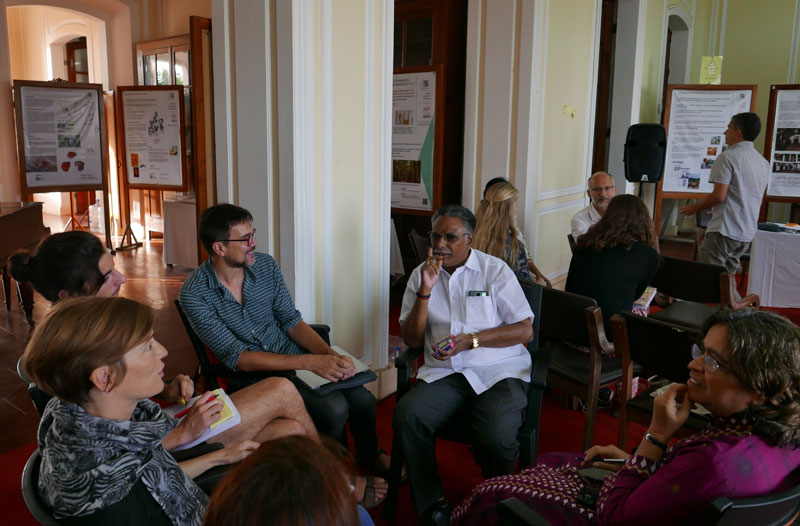
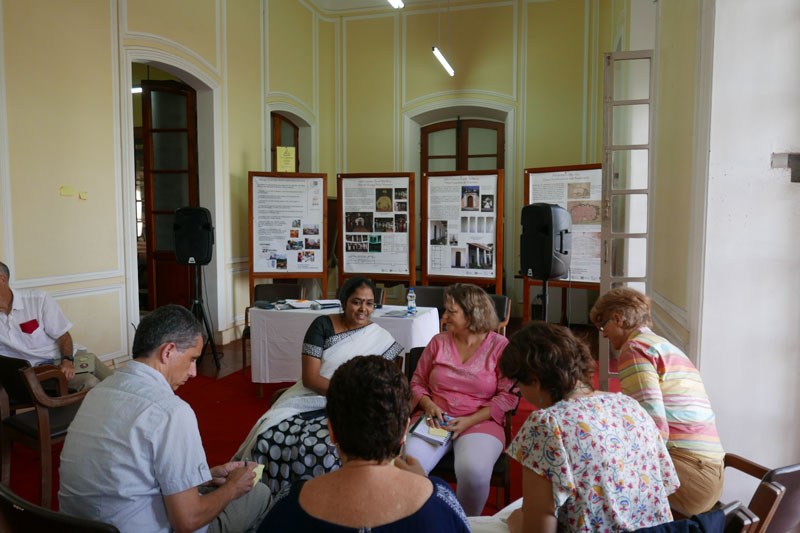
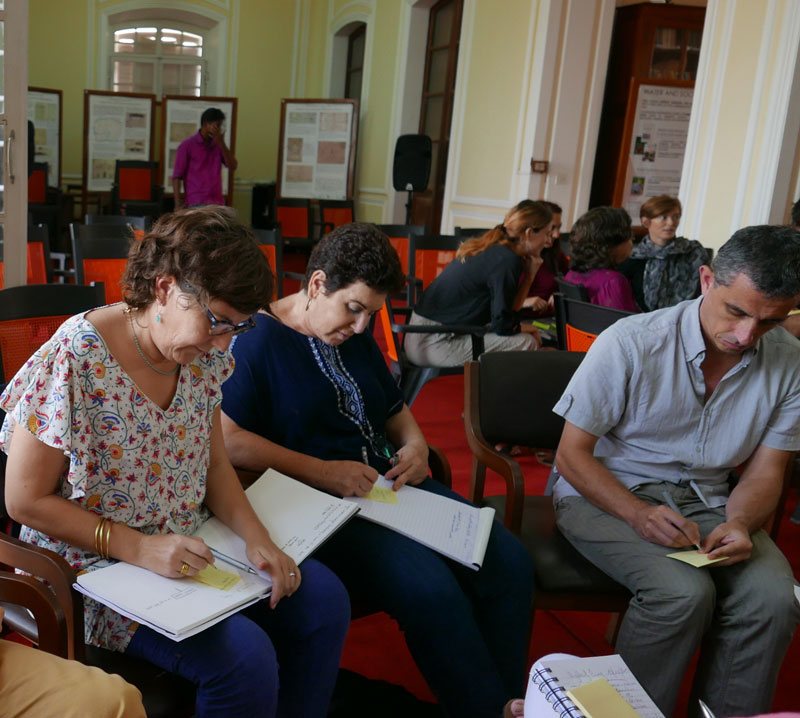
It emerged that cultural differences were fundamental in the plurality of definitions to be retained, as the notion of a boundary is much more flexible for Indians, including jurists. For example, when asked whether a deceased person could be considered as living, the French responded "clearly not!" and the Indians "they are alive in a different way".
This workshop raised more questions than it provided answers, so reflections took the necessary time to mature. A "great cases of living law" format was considered but abandoned because it would only cover case law and litigation, leaving out laws and local regulations, as well as doctrine.
Thus, after much reflection, the Chronicles of Living Law were born. The next step was to find a captain to steer this new vessel through uncertain waters, as Professor Mercadal did for the Annotated OHADA Code, and to establish a framework for publication.
The Launch of the Chronicles
The Framework
There were convergences with the work and reflections of the International Happiness Observatory, whose Journal of Happiness Law, initially bilingual, then trilingual, was published online in 2019. Unanimously, the board members of the two institutions decided that it was within the framework of this international journal that they would develop and feed these Chronicles in partnership.
The Engine…

…as one is always needed, is Victor David in synergy with the members of the Scientific Committee and the members of IDEF India, an institution of which he is also a part. His skills and research field naturally designated him for this role.
Short biography
Born and raised in Pondicherry, Victor DAVID holds a doctorate in law and social sciences from the Université de Paris Sciences et Lettres/EHESS. He is a Research Fellow at the Institut de Recherche pour le Développement (IRD) and a Member of the Institut Méditerranéen de Biodiversité et d’Ecologie (IMBE). He is based in Marseille at the Faculty of Pharmacy at La Timone.
He studied law, political science, and British language and civilization at the University of Paris X Nanterre.
His current research activities and expertise focus on developments in environmental law, and he is a recognized specialist in the Rights of Nature field in France. His research also focuses on environmental health issues. Having lived for 20 years in New Caledonia, he is also interested in the rights of indigenous populations and in contexts of cultural and legal pluralism.
As part of its Voluntary Commitments to the United Nations Conference on the Oceans, Victor is also the IRD’s project leader for a feasibility study on the recognition of the Mediterranean Sea (2022 - #OceanAction46735) as a natural legal entity, with the MerMéd Project.
Since December 2022, he has been a member of the IUCN World Commission on Environmental Law (WCEL).
Case Law and Litigation
En septembre 2024, l’organisation des chefs du Sud de la province de Manitoba au Canada a saisi la Cour du Banc du Roi du Manitoba, avec l’aide du Centre juridique d’intérêt public et de First Peoples Law à Vancouver, pour obtenir une déclaration selon laquelle le lac Winnipeg a des droits à la vie, à la liberté et à la sécurité de la personne en vertu de l’article 7 de la Charte canadienne des droits et libertés. Au banc des accusés, le gouvernement du Manitoba et Manitoba Hydro à qui il est reproché d’avoir contrôlé artificiellement et sans étude d’impact environnemental préalable, les niveaux d’eau et le débit de l’écoulement du lac Winnipeg pendant des décennies, ce qui a été « complètement négligent » et a eu des effets "désastreux" sur le lac selon le porte-parole des Chefs, Jerry Daniels. De manière intéressante, celui souligne le lien entre santé environnementale et droits humains des premières Nations : « C’est tout simplement irresponsable. Les zones humides sont en déclin. Les poissons sont malades. Les espèces envahissantes sont arrivées, et les Premières nations se voient refuser leurs droits autochtones inhérents et leurs droits issus des traités », a-t-il déclaré. S’appuyant sur les précédents de la rivière Magpie au Québec et le fleuve Whanganui en Nouvelle-Zélande, la requête pour que le tribunal déclare que l’interférence avec les flux naturels du lac sans évaluation environnementale a violé les droits du lac lui-même et des citoyens des Premières nations qui en dépendent a été déposée par un groupe qui se « nomme Nibi Naa da maa geayuk (ceux qui parlent au nom du lac et le protègent) ».
A suivre !
Source presse : https://www.cbc.ca/news/canada/manitoba/southern-chiefs-organization-lake-winnipeg-charter-challenge-1.7328001
Zone : Canada
Dans cette décision de justice, dans une affaire relevant du Dieselgate (voir Aggeri, F., & Saussois, J. M. (2017). La puissance des grandes entreprises mondialisées à l’épreuve du judiciaire : De l’affaire Volkswagen au dieselgate. Revue française de gestion, (8), 83-100.), le tribunal régional d’Erfurt a fait un pas très important dans l’introduction des droits de la Nature pour la première fois en Allemagne. Dans une affaire banale pourrait-on dire de responsabilité du constructeur automobile poursuivi pour dédommagement par un client du fait du trucage du moteur pour le calcul du taux réel de pollution, les conséquences du jugement sur le droit allemand et celui de l’Union Européenne en particulier pourraient ne pas être anodines. Estimant que si la fraude du constructeur automobile Volkswagen doit bien être retenue dans le règlement du litige en tant que tromperie industrielle, le jugement va delà et considère que « [L]’infraction commise par la partie défenderesse a un poids considérable » par les atteintes à l’environnement causées par des émissions de GES non comptabilisées. Ce jugement est en tous cas plein d’audacieuses innovations fondées sur des interprétations inédites par le juge (à commencer par le poids même de cette Charte en droit de l’UE) de différentes dispositions de la Charte des droits fondamentaux de l’Union Européenne dont « découlent les droits propres de la Nature », notamment des articles 2 (droit à la vie), 3 (intégrité de la personne) et 37 (protection de l’environnement). Considérant que la Charte n’est pas à prendre à la lettre mais comme un « instrument vivant » qui « permet de répondre aux nouvelles menaces » comme le changement climatique ou l’érosion de la biodiversité et diverses pollutions, le juge considère le concept de « personne » utilisé dans la Charte comme s’étendant au-delà des sujets humains à ce qu’il appelle les "personnes écologiques", c’est-à-dire les écosystèmes et les entités naturelles qui soutiennent la vie sur Terre ! « La reconnaissance de droits propres à la nature sert » l’objectif essentiel de l’Union décrit à l’article 37 qui est de garantir « un niveau élevé de protection et d’amélioration de la qualité de l’environnement doit être intégré dans les politiques de l’Union et assuré selon le principe du développement durable. » Le jugement est particulièrement intéressant en ce qui concerne l’interprétation de l’article 37 qui est plutôt considéré comme imposant des obligations aux États, car il reconnaît aux écosystèmes eux-mêmes des droits.
Nul doute que ce jugement fera date, surtout s’il est confirmé par des cours de niveau supérieur et on espère que d’autres cours de justice à travers l’Union Européenne s’en inspireront pour faire progresser le droit du Vivant sur le Vieux Continent.
Zone : Allemagne – Union Européenne
[Versions originale et française du jugement disponible sur demande]
En 2022, l’Espagne était le premier pays de l’Union Européenne, de tradition civiliste à reconnaître, par le biais d’une loi nationale un écosystème en danger, la lagune Mar Menor, comme sujet de droit. La loi 19/2022 avait été contestée par le parti Vox et 50 membres de la Chambre des Députés avaient saisi Tribunal Constitutionnel espagnol.
Le recours de Vox se basait sur différents arguments suivants :
Inconstitutionnalité en matière de compétences : Les opposants estimaient que cette loi portant sur l’environnement ne pouvait pas concerner une portion du territoire national. Ils soutenaient que cette législation nationale aurait dû s’inscrire dans un cadre plus respectueux des prérogatives régionales, notamment en matière de gestion des ressources naturelles et de protection de l’environnement (articles 148.1.9 et 149.1.23 de la Constitution). Ils affirmaient dans le recours que la loi 19/2022 "enfreint le système constitutionnel de répartition des compétences entre l’État et les Communautés autonomes" car "l’objet de la loi indique clairement qu’il ne s’agit pas d’une loi cadre de protection de l’environnement applicable à l’ensemble du territoire national et que, par conséquent, il ne reviendrait pas à l’État de l’élaborer".
Il faut rappeler à ce sujet que l’initiative populaire pour la reconnaissance de la Mar Menor auprès de l’assemblée locale avait échoué, conduisant ses porteurs, en particulier la Professeure Teresa Vincente Gimenez, à passer à une initiative auprès du Parlement espagnol à Madrid.
Violation du principe d’égalité : La loi confèrerait des droits subjectifs spécifiques à un écosystème (la Mar Menor) sans que ce mécanisme soit appliqué de manière uniforme à d’autres environnements similaires en Espagne, ce qui pourrait être perçu comme discriminatoire.
Complexité juridique : Pour les opposants à la loi, la création d’une personnalité juridique pour un écosystème posait des questions quant à son application concrète, notamment en matière de gouvernance et de responsabilité juridique. Des critiques, que l’on entend régulièrement dans les contextes de reconnaissance de droits à des éléments de la Nature, avaient également été émises sur la compatibilité de cette mesure avec les cadres existants de protection environnementale, considérés comme suffisants s’ils étaient correctement appliqués.
Dans sa décision rendue publique le 21 novembre 2024, le Tribunal Constitutionnel espagnol a rejeté le recours en estimant la loi qui reconnait la Mar Ménor comme personne juridique ne violait aucune disposition de la Carta Magna. Le Tribunal déclare qu’il « s’agit d’une technique nouvelle dans notre droit de l’environnement, bien qu’elle s’inscrive dans un mouvement international croissant au cours de la dernière décennie, qui promeut la reconnaissance de ce que l’on appelle les droits de la nature. » et que la loi respecte bien le partage de compétences entre État et provinces autonomes. Le Tribunal rappelle une décision précédente de 1995 qui « a reconnu que l’environnement est un "concept essentiellement anthropocentrique", mais a également déclaré qu’il s’agit d’un concept relatif, concret et dynamique. Il est souligné qu’il appartient au législateur de déterminer les techniques appropriées pour mettre en œuvre le principe directeur de l’article 45 de la Constitution, et qu’il a désormais adopté une vision plus écocentrique. Il est également souligné que l’attribution de la personnalité juridique est différente de la personnalité physique, sans porter atteinte à la dignité humaine, et que la Constitution ne réserve pas la protection juridictionnelle effective à un certain type de personne. »
Avec cette décision, le Tribunal Constitutionnel espagnol confirme le statut de sujet de droit accordé par la loi à la lagune Mar Menor et confirme ce faisant la place de pionnière au sein de l’Union Européenne de l’Espagne en matière de reconnaissance de droits de la Nature.
Sur la loi 19/2022, voir : DELZANGLES, Hubert. La reconnaissance, en Espagne, de la personnalité juridique et de droits à la « Mar Menor ». Une contribution à la réflexion sur les « biens communs environnementaux ? ». Revue juridique de l’environnement, 2023, vol. 48, no HS22, p. 173-182.
SOHNLE, Jochen. La personnalisation juridique de Mar Menor en Espagne–Un premier pas en Europe vers l’émancipation juridico-politique des éléments de la nature. Revue juridique de l’environnement, 2023, p. 271-287.
AVIÑÓ BELENGUER, David. La loi 19/2022 espagnole, au-delà de la personnification de la Mar Menor (région de Murcie, Espagne). Une ouverture vers une action populaire et une responsabilité civile environnementale ? 2024. https://revista-aji.com/la-loi-19-2022-espagnole-au-dela-de-la-personnification-de-la-mar-menor/
YZQUIERDO, Marine. Ils se sont battus pour que la lagune devienne un sujet de droit. DARD/DARD, 2023, vol. 8, no 1, p. 145-155.
Sources : https://www.tribunalconstitucional.es/NotasDePrensaDocumentos/NP_2024_115/NOTA%20INFORMATIVA%20N%C2%BA%20115-2024.pdf
https://murciaplaza.com/el-constitucional-admite-el-recurso-de-vox-para-frenar-la-personalidad-juridica-del-mar-menor
https://murciaplaza.com/el-constitucional-desoye-a-vox-y-respalda-la-ley-que-reconoce-la-personalidad-juridica-del-mar-menor
Zone : Espagne – Union Européenne
Local Legislation / Regulation
Début août 2024, la municipalité côtière située dans l’Etat de l’Espirito Santo a adopté une décision qui confère aux vagues situées à l’embouchure du fleuve Doce, qui coule vers la côte atlantique du Brésil, le droit intrinsèque à l’existence, à la régénération et à la restauration.
La présence des vagues est en fait liée au bon fonctionnement écologique du fleuve Doce. Or celui a été gravement affecté lorsque le barrage de Mariana s’est effondré en 2015, ce qui a dévasté la région (19 morts, inondations de villages). La rupture du barrage a libéré 43,7 millions de mètres cubes de résidus miniers dans la rivière Doce (source Wikipedia), et qui ont enseveli le lit du fleuve de sédiments toxiques stockés. Le flux du cours d’eau et la vie aquatique jusqu’à l’embouchure et le littoral ont été profondément affectés au point d’arrêter la dynamique des vagues. De graves inondations en 2022 ont eu pour conséquence de nettoyer le lit du fleuve qui a retrouvé un débit suffisant et ainsi permettre le retour des vagues. C’est l’action menée par des militants environnementaux face aux atteintes environnementales et des surfers qui ont conduit la municipalité à prendre cette délibération qui accorde aux vagues et au fleuve des droits à l’instar de ceux reconnus ailleurs aux éléments de la Nature. En cela, la règlementation de la municipalité de Linhares va au-delà de la décision du gouvernement péruvien d’accorder en 2016 une protection juridique à la fameuse vague Chicama, sur la base d’une loi de 2001 destinée à protéger les spots de surf.
Zone : Amérique Latine
Source presse : https://jack35.fr/2024/09/12/legalement-reconnu-ses-precieuses-vagues-comme-des-etres-vivants-au-bresil/
Books and Doctrine
Editions de l’AFD.
Fin juillet, l’Agence Française de Développement (AFD) a publié un ouvrage, magnifiquement illustré sur les droits de la Nature. On y trouve un historique du mouvement des droits de la Nature, des case studies sur tous les continents qui témoignent d’initiatives citoyennes en faveur des droits du Vivant, qui aboutissent ou non à leur intégration dans les ordres juridiques des pays concernés. L’intérêt de cet ouvrage, c’est qu’il est le premier sur les droits de la Nature à parler des droits de la Nature comme inséparables des droits humains au développement. A découvrir des articles en dernière partie qui reviennent sur le rôle du modèle économique libéral actuel qui est à l’origine d’une exploitation sans limite de la Nature.
L’ouvrage est disponible en ligne en français, anglais et espagnol à l’URL : https://www.afd.fr/fr/ressources/droits-de-la-nature
Zone : Monde
Crédits
Publication policies
Editorial definition
Title: Revue Juridique du Bonheur
ISSN electronic format: 2678-3312
Frequency: Annual
Year of creation: 2019
Publisher: Observatoire International du Bonheur
Copyright and distribution policy
Open access publication
Publication fee policy
Publication fee: no
Submission fee: no
Evaluation policy
Evaluation procedure: double-blind evaluation
Join the OIB
Do you want to be informed, get involved? You can become a member of the OIB
ONLINE FORM
PAPER FORM
I participate
Communicating is precious!
Don't hesitate any longer and share your comments with us!
Nous contacter
Make a donation
Communicating is precious!
Don't hesitate any longer and share your comments with us!
Learn more
MESSAGING
Contact OIB
Adress:
14 Rue Marcel de Serres
34000 Montpellier
France
E-mail:
contact@oib-france.com